Sociology
Painting and Sociology
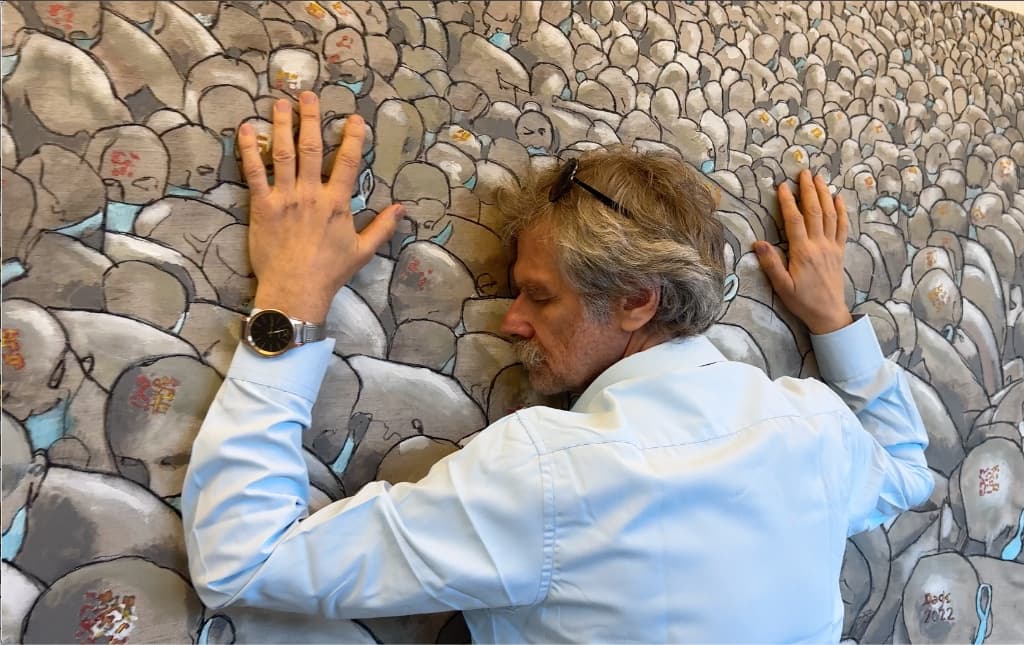
Dags has studied various art styles, studying at the Academy of Arts twice. In search of their artistic authenticity, the combination of methods created their own technology, painting themes and forms of expression. The main periods in the artist's work are Dags' education and the trajectory changes created by the lands and cultures he has traveled. The main task of intellectual creation is to use the language of art to defend the socially discriminated sections of society. As the formations of civilization change, so does the message and style of Dags' art.
The social activity of Dags Vidulejs is to establish non-governmental structures in culture, as set by Vaira Vīķe Freiberga during her presidency. In complete solitude, without the support of financial structures, going upstream in the former post-Soviet society in Eastern Europe. Establishment and free exchange of non-governmental self-financing art traditions, symbolizing the free individualism of Western culture and Celts (www.linkedin.com/in/artriga/). Dags is an Art Process Manager, Producer group curator and director (2006-2020). Working at Pinakoteka (2500 m² exhibition building), board member, managing financial schemes and construction. Happy Art Museum curated more than 300 international exchange art exhibitions (www.facebook.com/HappyArtMuseum). Dags is the founder of ART RIGA FAIR for the long-term growth of the Latvian art market and the initiator of art auctions.
The guiding principle of Dags' Vidulejs work is to try to find a new expression for painting as a medium. In the age of technocracy, competing with mobile technology media. It took many years and 1,000 drawings to learn to sketch figures from nature in order to be able to create compositions of anthropomorphic forms freely. Exhibiting large-format paintings in the counterpoint method in triptychs with current contemporary messages, achieving interactivity with the audience. The primary mission of Dags' Art is to inspire the viewer to a conversation, to inspire love through the exchange of art exhibitions, participating in ART MOSCOW, Belgian, German, Lithuanian, Chinese, Finnish, Israeli and other art fairs and international exhibition halls with their paintings.
The studies of the Academy of Arts, not only in conceptual painting, but also in sociology, arranging museums and curating exhibitions, gave the opportunity to work in the style he had created. Over the years, dozens of large-format paintings have been made. In recent years, most have been sold at foreign exhibitions to maintain the family-run HAPPY ART MUSEUM and ART RIGA FAIR. Public activity goes against the current in the former totalitarian corrupt society of Eastern Europe, establishing non-governmental self-financing art traditions and free exchange, which symbolises the free individualism of Western Culture. However, in the last two years, there have been no sales opportunities due to regulations restricting travel and suspending exhibitions. The self-employed and the creative industries are currently banned from serving people and earning a living. However, a total of forty paintings have been successfully accumulated. Not included in one hall, they are exhibited in two parallel solo exhibitions: Latvian Railway Museum and Līgatne Gallery ZEIT. The author continues to work in his individual style, looking forward to cooperation plans with the budgeted institutions and awaiting invitations from other museums.
I have been working on the implementation of the structuralist method in painting for several decades. Studying sociology in depth after my second studies at the Art Academy of Latvia. This is a new method in Latvian art that can enrich the palette of artists' expressive means, as well as actively enrich the expansion of perception of society and the individual. Dozens of exhibitions have been organized and about a hundred works created in this direction.
Structuralism in painting is based on the assumption that observable objects exist not in isolation (in the sense of subjectivity), but in connection with other objects — in structures, despite the volatility and ambiguity of structures.
The exhibition is based on the diptych form, which allows juxtaposing paintings using the counterpoint method, achieving interactivity with the viewer and generalizations in the comparison process, similar to thought processes. Just as drama is based on the conflict of opposites, a structural thinking system processes the world through binary oppositions (e.g., black and white, high and low, person and animal).
Through these oppositions, cultivated as 'good' and 'bad', every culture and its traditions, politics, religious rituals, games, and education are built. Reproducing whole systems of opposing signs according to a pre-established structure creates cultural strategy and ideology. Culture operates as a semiotic system of signs structuring the communication process and giving it predictability, ensuring unified presentation and interpretation of exchanged messages.
Democracy-Totalitarianism, Christianity-Satanism, Communism-Fascism, Corruption-KNAB, Pandemic-Vaccine, USA-Russia, European Union-Soviet Union. However, the more one tries to prove antagonism, the more the concepts merge into a single unity of opposites, especially with the passage of time—like expansive fascism and expansive communism intertwining into a single two-headed tangle of 'World War II'. In connection with current social changes, such critical discourse is an analysis of the balance of power in society.
Social objects studied in structuralism are relative rather than substantive. The social world is explained not by individual actions, but through relations and relations between relations. The whole is formed as a differential articulation of subjects: stable, differential differences between individuals and groups. Articulation of interests is a function of the political system, enabling political parties to identify the demands of societal subjects on the current political system.
In art, structuralism is a parallel development path for abstraction, which occupied a major part of 20th-century art. Structuralism and abstraction share common slogans: 'Attack on Realism', 'Denial of Photographic Perception of Objects'.
The metatheoretical framework of structuralism provides a unifying, interdisciplinary approach. Structuralism opposed the Positivism of scientific methodology, which defines empirical research as the only source of true, valid knowledge. Structuralism justifies the cognitive value of philosophical research, denying Positivism's main thesis that 'All true knowledge is the cumulative result of special sciences'.
Structuralism denies Naturalism in painting and natural science methods as explainers of social phenomena. Naturalism claims the world is independent of consciousness and can be explored directly through automata and artificial intelligence. Naturalism as a branch of sociology also explains social history and future activities through various climatic, geographical, and biological factors.
Structuralism also denies Humanism as a method of inquiry, according to which humans construct and know their world, and know themselves as members of an imagined abstract integral society. In reality, an individual experiences society as a site of struggle for survival with vital, antagonistic interests of opposing groups hidden behind a common national or geographical identity. Without identifying their belonging, individuals fail to analyze and defend their actual position in a class society with layers that do not overlap in lifestyle, opportunities, or rights.
Structuralism also denies Structural Anthropology, which projects the elementary structures of family kinship onto societal structures, isolating homogeneous structures. Such structures have been preserved to this day in Eastern clan societies, as well as in the ancient families secretly controlling Western finances, who meticulously trace their bloodlines. In contrast, in Western civil society, kinship and family bonds are almost completely eradicated—not recognizing Mother or Father in passports, ignoring family as a child-creating unit, losing family properties, and abandoning mutual selfless help.
The sociological method, by identifying a huge difference in homogeneous subcultures, helps individuals identify and position themselves within a local society, socializing in the context of humanity. It allows identifying the dominant belonging of each person in the infinite array of subcultures, seeing subcultures as living collective organisms and analyzing their interaction.
Structuralism in painting is a dispassionate method in art and inquiry into culture and society, rather than a tendentious Foucault philosophy. It is an approach close to professional journalism that depicts facts without emotional judgment. Moreover, Structuralism differs from general scientific structural analysis, architectural structuring, structural differentiation in psychology, and general systemic scientific approaches.